compare
Two front axles, one sweep.
What was edited
Six hardpoints, 20 mm each
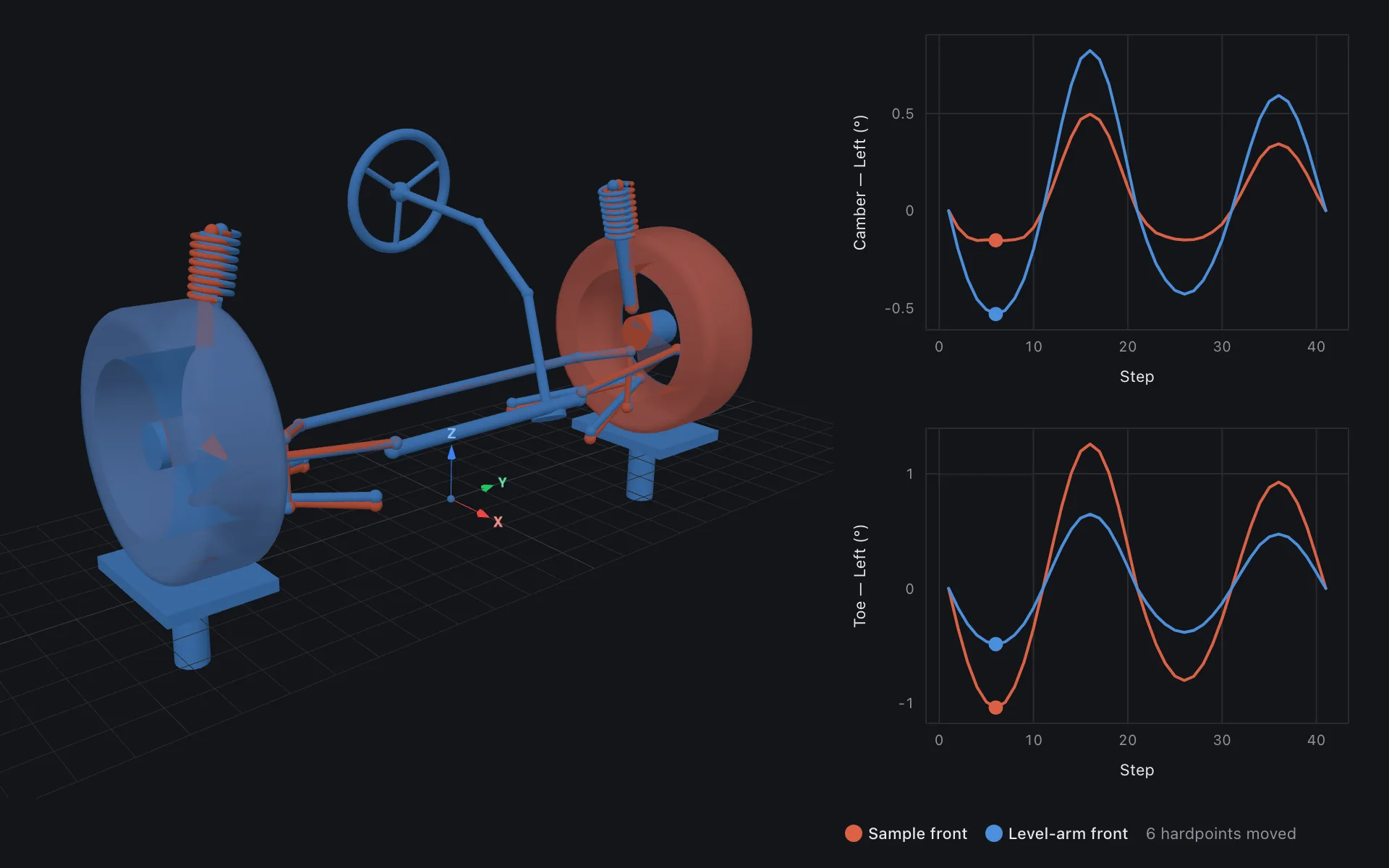
Level-arm front is the Sample front with six hardpoints moved: the inner pivots of both lower control arms raised 20 mm, front and rear, and both strut top mounts moved 20 mm inboard. At ride height, the roll center moves from about −24 mm to about +34 mm.
What to look at
Camber and toe, step by step
Heave runs first, ±40 mm, then roll, with the two posts moving ±30 mm in opposition. The edited front changes camber more through both: the two camber curves separate by up to about 0.38°. Its toe moves less — about −0.49° to +0.65° over the sweep, against −1.04° to +1.26° for the Sample front.
In your account
Your own results, side by side
Stack two or three of your own results in one 3D scene, charted together, with color-coded deltas against the baseline you pick. Result comparison is part of Pro, Teams and Student Teams.
result
Every channel a suspension engineer asks for.
Per corner, per step, straight from the solver's post-processor.
- Wheel & axle Camber, toe, wheel travel, contact patch, track.
- Centers Roll center and instant centers, front- and side-view.
- Steering axis Caster, kingpin inclination, scrub radius, trail and ratio.
- Installation Motion ratio, coilover compression, anti-roll-bar torsion.
- Raw geometry Every hardpoint and body pose, at every step.
- Rig inputs Plot any channel against the real rig input.
MCP
Drive it from your coding agent
Add bellcrank's MCP server at api.bellcrank.io/mcp with your own API key, and your agent can build an axle, run a sweep and read the channels back from Claude Code, Cursor or any MCP client that can send an API key header.
Solve something today.
Create an account, model a suspension from your own hardpoints, and run it on the rig. No download, no license, no payment details — and the free tier is permanent.
- No payment details
- Nothing to install
- Runs on any OS
- Permanent free tier